Neuroscience10 September 2026
Turning the fly bisexual
Nico Christie and Peter Wang
In our words
I turned the fly bisexual
Inspired by Kallman et al ('15), I blocked mAL output in a 166,606-neuron fly model and measured responses in 8 candidate P1 male courtship neurons.
In 3 experiments, when cued by other males, baseline P1 spikes rose from 0 to 1–5 after mAL blockade
@nicochristie on X · 10 September 2026
Male-cue responses consistently rose from 0 to 1–5 spikes across three trials after mAL output was blocked.
Female-cue responses rose from 8–11 to 18–20 spikes.
Female preference always dominated... maybe the most accurate description is I made the fly sexually frustrated.
@nicochristie on X · 10 September 2026
huge shoutout to @BrainsAndTennis
I texted him about this idea, and he told me its actually possible and pointed me to the actual literature
my work wouldnt have been remotely scientific without him
@nicochristie on X · 10 September 2026
What we did
We asked a small question: does blocking mAL output let male-associated sensory input activate a courtship-related group of neurons? Earlier biological work identifies mAL as an inhibitory pathway—a brake on courtship circuitry.
We used the measured MaleCNS wiring graph: 166,606 classified neurons and approximately 25.6 million connections. Simple spiking-neuron rules turn that anatomy into a simulation. Neurotransmitter labels and functional research guide which outputs excite or inhibit other cells; these effects remain modeling assumptions, not measured properties of every connection.
The experiment compares the same network receiving identical sensory inputs with one intervention: blocking mAL output. Inputs, connection rules, and firing thresholds stay fixed within each pair. We measure spikes in eight literature-mapped P1-related candidate neurons, without directly stimulating them. This makes the paired difference attributable to mAL output block within the model.
We tested all 36 combinations of three input pathways, three random seeds, two inhibition settings, and intact versus blocked mAL output. Repeating the comparison checks whether the effect survives changes in input randomness and inhibitory strength. It does not establish that the assumed cell identities, connection effects, or sensory inputs are biologically correct. Earlier exploratory experiments and model revisions are documented in the full report.
What happened
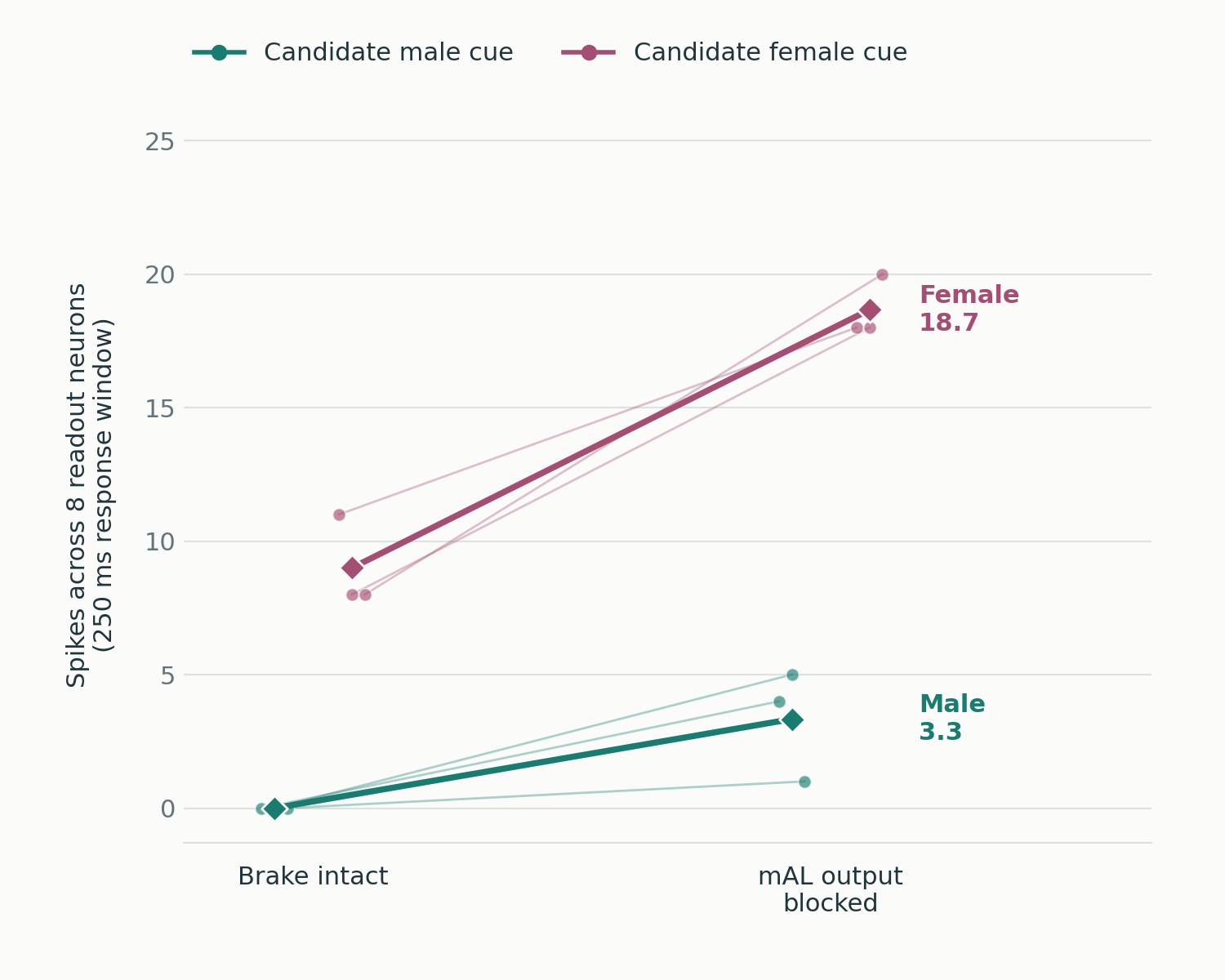
In the setting shown in the chart, male-cue responses rose from zero to 1–5 spikes across three trials after mAL output was blocked. Female-cue responses rose from 8–11 to 18–20 spikes. The second inhibition setting also showed an increase in male-cue responses.
The model showed increased responsiveness to male cues, not male preference. Female cues still produced stronger responses. The result depends on assumed connection effects, candidate cell identities, input encoding, and neuron dynamics; it is not a biological replication or a fruitless gene edit.
The science behind it
nico abliterated the fly brain to make it bi
heres the science behind it. my qualification is that a lot of this science either happened directly in my phd advisor's (richard axel) lab or happened within / close to the scientific fam
fruit fly brains, like our brains, are sexually dimorphic, meaning that there are clear and hardwired differences in neural circuits between males and females. this is established by a small set of genes, one of which is called fruitless. 20 years ago, my friend and past labmate Ebru Demir wrote a sick pape: she abliterated real female fruit fly brains and made them gay by giving female fruit flies male-splice variants of fruitless (pubmed.ncbi.nlm.nih.gov/15935764/)
the circuits that are sexually dimorphic appears to span the entirety of the sensory -> "cognitive" -> motor pathway. nico's targets, mAL -> P1 pathway, titrates courtship drive towards male and female fruit flies. it's a particularly interesting circuit because it's very yin yang: the balance of excitation and inhibition provides a physical substrate for titrating heterosexuality.
P1 neurons promote courtship. mAL neurons inhibit P1 neurons and therefore inhibits courtship. female-responsive sensory cells recruit both direct excitation of P1 AND mAL-mediated inhibition. in contrast, male-responsive sensory neurons prominently recruit mAL, which inhibits courtship. so the existence of both an E and an I pathway serve as knobs for evolution to tune heterosexual drive. see elifesciences.org/articles/11188 and pubmed.ncbi.nlm.nih.gov/26279475/
in nico's demo, he turned off mAL neurons, so he made fruit flies hornier to both males and females, driving increased courtship to both male and female flies
@BrainsAndTennis on X · 10 September 2026
Credits
MaleCNS data: CC-BY. NeuroMechFly / NeLy-EPFL meshes: Apache-2.0, notices in `assets/fly/`. Three.js: MIT. Inspired by Kallman, Kim & Scott (2015).